lunes, 12 de noviembre de 2012

Baden Powell's Biography


Peter: Hey! who is that in your screensaver?

Diego: That's Baden Powell, he founded the boy scouts back in 1907.

Peter: Wow really? that's awesome! and his name is Baden Powell? That doesn't look like a name.

Diego: Actually, his full name is Lord Robert Stephenson Smith Baden-Powell of Gilwell, so Baden Powell is his last name.

Peter: Oh! that makes sense. And how old was he when he founded the boy scouts?

Diego: He was born in England on February the 22nd of 1857, so he was 50 years old when he founded them.

Peter: Well, he wasn't so young then! What did he do before that?

Diego: During his life, he was an outstanding military, so by 1889 he was already a coronel. Most of his missions were in Africa, but when he returned to England in 1901 he found that his book "Aids to scouting" was being used in the schools to educate the young men, so he decided to write a book about scouting specially for young men. In 1907 he finally decided to take some boys to Brownsea, and that was the first scout camp in the history.

Peter: That's a very interesting story! And when did he die?

Diego: He died in Kenya on January 8th of 1941.

Peter: He had a great life. I'm sure he inspired a lot of people all along history. And he brought scouting to Venezuela?

Diego: No, that was another man, his name was Ramon Ocando Perez, but that's a different story...


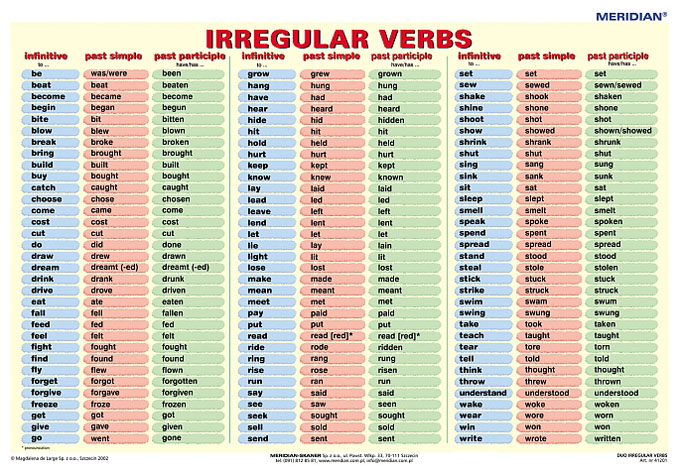
Irregular verbs

We know that learning all the irregular verbs can be very difficult for most of the persons, so to make it easier we leave you a list with all the irregular verbs, including their past ant their past participle.


Comparatives and superlatives

When we're comparing a feature or quality in two nouns, we use comparatives. There are some rules we need to follow for turning an adjective into a comparative:

  • If the adjective ends in "e", we add "r" at the end of the word.
  • If the adjective ends in a consonant, we add "er" at the end of the word (most of the times).
  • If the adjective ends in "y, we change the "y" for an "i" and then we add "er" at the end of the word.
  • If the adjective ends in vowel+consonant (only "g", "t" or "n"), we double the consonant and then we add "er" at the end of the word.
However, these rules are only for short adjectives. When the adjective is longer that three syllables, we only add "more" before the adjective.

Examples:
 Angry _____ Angrier
Brave _____ Braver
  Clean _____ Cleaner
       Intelligent _____ More intelligent

The superlatives are the words that we use when we want to say that a noun presents a quality more marked that any other. To form the superlatives from adjectives there are also some rules:

  • If the adjective ends in "e", we add "st" at the end of the word.
  • If the adjective ends in a consonant, we add "est" at the end of the word (most of the times).
  • If the adjective ends in "y, we change the "y" for an "i" and then we add "est" at the end of the word.
  • If the adjective ends in vowel+consonant (only "g", "t" or "n"), we double the consonant and then we add "est" at the end of the word.
However, these rules are only for short adjectives. When the adjective is longer that three syllables, we only add "the most" before the adjective.

Examples:
 Angry _____ Angriest
Brave _____ Bravest
  Clean _____ Cleanest
            Intelligent _____ The most intelligent

We need to be very careful because there are nouns with irregular comparatives and superlatives (they don't follow any rule), and the only way to know them is learning them by heart. For example:

 Good _____ Better/Best
      Bad _____ Worse/Worst

In this webpage we can find a very complete list of adjectives with their respective comparative and superlative: http://www.curso-ingles.com/gramatica-inglesa/compar-lista.php

Here are three webpages where we can practice comparatives and superlatives:
http://www.saberingles.com.ar/curso/lesson12/05.html
http://web2.uvcs.uvic.ca/elc/studyzone/330/grammar/regcom1.htm
http://www.usingenglish.com/quizzes/45.html


martes, 6 de noviembre de 2012

Present progressive (Future)


In my next vacations I'm going to Los Roques for a week.

I'm going to stay in a nice hotel close to the beach. 

The first day I'm going to buy all the food I will need during the week.

The second day I'm visiting my cousins who live there.

We are eating in a fancy restaurant and then they are taking me back to my hotel.

The third day I'm swimming in the hotel's pool and in the afternoon I'll go to the beach and I'm going surfing.

The fourth day I'm visiting the mall and I'm buying clothes and gifts for my friends back at home.

The fifth day I'm meeting a scubadiving instructor and we're going to a beach because I want to learn.

The sixth day of the week I'm hanging out with my cousins and we're visiting a museum with some of their friends.

The last day, I'm packing my bags because my flight departs at 9 am.


viernes, 19 de octubre de 2012

Sentences with irregular nouns

In English grammar, there are regular nouns (that obey to certain rules when you transform them in their plural) and irregular nouns. The irregular nouns change completly, don't change at all or don't obey to any specific rule, here are some examples:

My child is in the school./ My children are in the school.

There is a mouse in the kitchen./There are mice in the kitchen.

I broke my feet riding bycicle./ I broke my foot riding bycicle.

The man in the room is making me nervous./ The men in the room are making me nervous.

The woman in my reading club is a very good friend of mine./The women in my reading club are very good friends of mine. 

When I arrived home I had to change my clothes. (The noun "clothes" does not change in his singular and in his plural)

The fish we ordered was delicious. (The noun "fish" does not change in his singular and in his plural)

Yesterday at the mall I bought a pair of pants. (The noun "pants" does not change in his singular and in his plural)

Sentences with regular verbs in third person singular

I work everyday from 7 am to 4 pm./ She works everyday from 7 am to 4 pm.

When I come home everyday, my dog is waiting for me./ When she comes home everyday, her dog is waiting for her.

I go to my french course every saturday./ She goes to her french course every saturday.

Every night I watch a movie with my family./ Every night she watches a movie with her family.

You cry every time you see that movie./ He cries every time he sees that movie.

Your wife is in the kitchen./ Their wives are in the kitchen. (Plural noun)

I lay down in my bed when I do not feel good./ He lays down in his bed when he does not feel good.

Your banjo is broken./ Their banjos are broken. (Plural noun)

lunes, 15 de octubre de 2012

My daily routine

Hello, I'll describe you a normal day in my life. Normally, I wake up at 6:00 am and immediately I get up, I go to the bathroom and I brush my teeth, then I get dressed and comb my hair. Every day my grandmother makes my breakfast, so I grab it and I get in the car. Usually I leave my house at 6:30 am and I eat in the way to my university. I get to class at 6:50 am and my first class starts at 7:00 am, so I arrive early all the time. Usually I have two or three classes in the day, so I go home approximately at 1:00 pm. I always walk from the university to the bus stop in Santa Monica, and it takes me home. I arrive to my house normally at 2:30 pm, then I have lunch and the rest of the afternoon I take care of my nephew until my family gets home (often they arrive at 7:00 or 7:30 pm). When they arrive, we have dinner and we talk for a while and then my nephew goes to sleep at 8:30 pm, so I shower and then I start to do all my homework and I take some time to study. When I don't have any assignments to do, we all watch a movie and then I go to sleep normally at 11:00 pm.